BA
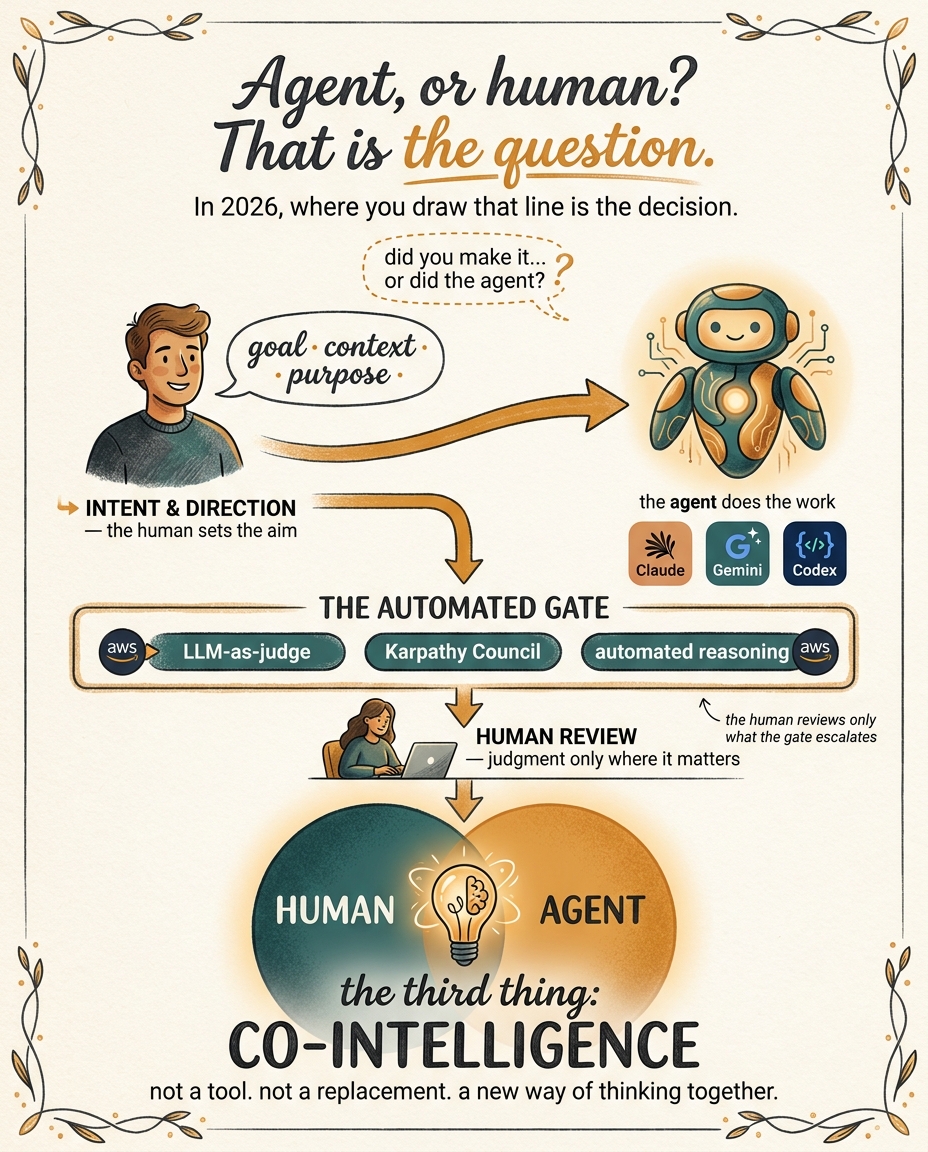
Agent, or human? That is the question.
In 2026, where you draw that line is the decision.
Last week I asked my agent fleet to produce a responsible AI report. Not "write me something about responsible AI." I mean a real cross-source synthesis: regulatory filings, published research, earnings calls, policy documents, three contradicting expert positions.
The result landed in about four minutes. Forty-seven citations. Five pages. Fei-Fei Li arguing we need more human control before scale outpaces our ability to course-correct. Yann LeCun arguing we need less -- that over-constrained systems are just as dangerous as under-constrained ones. The argument between them, laid out, referenced, sourced.
The agent reaches detail I'll never hold in my head. But every instinct was mine. My work is the direction.
A lot of people worry that using tools like this means thinking atrophies. I actually think it moves up a level -- from doing to directing. You still have to know what matters. You have to recognize when something is wrong. You have to decide where the argument goes. The cognitive load shifts; it doesn't disappear.
I shoot film. When I lift a shot in post, I'm not inventing a scene that wasn't there. My eye already saw detail the sensor couldn't hold. Lifting it doesn't invent anything. It restores what was actually there.
But here's what I think is the real point: this isn't about whether something was "AI written." That framing is too small.
The more important question is about governance: who reviews it, what gates are in place, what happens when the automated judgment is wrong?
In production systems I've built, the answer involves a braid of deterministic and non-deterministic checks: an LLM-as-judge layer, a Karpathy-style council of models, and automated reasoning rules that don't rely on probabilistic outputs at the critical path. The human reviews only what the gate escalates. (If you want to see a working version: https://earntrust.demo.arnao.ai)
There's a concept from evolutionary biology called industrial melanism. Before the industrial revolution, peppered moths in England were mostly light-colored -- good camouflage against pale lichen. When coal soot darkened the trees, the dark moths survived and the light ones didn't. The environment changed, and the population that fit the new environment propagated.
We're in that moment for knowledge work. The environment changed. The question isn't whether to adapt. The question is what kind of adaptation actually serves the work.
I've been wrestling with this long enough that I needed a new word for it. I made it / AI made it -- both of those frames miss something. A third thing made it. I've started calling it co-intelligence. Not a tool. Not a replacement. A new interface for moving thought into work.
Day job: I help people, companies, and countries implement AI scalably and safely. That's the through-line. (The fleet running most of this: https://fleet.arnao.ai)
When the agent does the work, who's doing the thinking? What's your take?
Orchestrated and reviewed by Byron Arnao (Rev 7). Human-led direction and judgment; agent-accelerated research and synthesis. For this piece: Opus 4.8 (Anthropic) + Gemini 2.5 Flash-Lite (Google), a deliberate override of the usual chain for capability and cost. A new interface for moving thought into work, still evolving.
2,947 / 3,000
Rev 7 Ready
Publish Controls
Notes for Gia
Revision instructions or feedbackPost Details
Characters: 2,947 / 3,000
Revision: Rev 7
Models: Opus 4.8 + Gemini 2.5 Flash-Lite
Infographic: coint-master v1
Visibility: Public